NOL World
Account
2011 Vienna Boys Choir New Year's Concert

2011 Vienna Boys Choir New Year's Concert

Date/Time
Jan 22, 2011
Genre
Family
Venue
Seoul Arts Center, Concert Hall
Age group
over 7 years old
Run time
2 hr (Intermission 15 min)

Price

More detailed ticket information will be available when you book the tickets.
  • Stray Kids
  • SEVETEEN
  • Stray Kids
  • SEVETEEN
1/2
Untitled Document

JUMP-START the New Year with the Vienna Boys Choir
2011 Vienna Boys Choir New Year’s Concert


Pump up for the New Year with the heavenly voices of the Vienna Boys Choir!
Witness the serenity, tradition and poise
of the world’s oldest and best known boys choir!
Light up 2011 with family and friends with the Vienna Boys Choir New Year’s Concert!


* Date: Saturday, January 22, 2011
* Time: 8 PM
* Artist: The Vienna Boys Choir Haydnchor, Conductor: Kerem Sezen
* Program: Medieval church music, Austrian favorites, Motion Picture Soundtracks, Pop and more
* Booking: Club BALCONY -> 02-1577-5266


** For More Information, please contact EJ Cho (02-318-4301), CREDIA


1. The world’s oldest Boys Choir, boasting a history of 500 years and a music education system built on culture and tradition!
2. The best New Year’s outing for your family!
3. Presented by the Haydnchor, praised by fans as the best team of all four of Vienna Boys Choirs!


The Vienna Boys Choir in Seoul

The Vienna Boys Choir, backed by a history of 500 years as well as the courtly tradition of the Austrian royalty, comes to Korea again to open the New Year with their heavenly voices. Having had masters like Schubert and Haydn as members of the choir, Beethoven to accompany their singing, Wagner, Liszt, and Johann Strauss to dedicate works specifically written form them, the Vienna Boys Choir stands at the top of the world of choral music and will be here in January to dazzle the Korean audience once again.

Established and supported by the Austrian government and other private foundations for over a century, the Vienna Boys Choir is trained through a disciplined music education system. Representing this special training, the Choir will sing a repertoire ranging from medieval church music to modern Pop. Covering hundreds of years and a great variety of genres, the Vienna Boys Choir will mark the best of all New Years events for family and friends.

Since their first visit to Korea in 1978, the Choir has been presenting annual concerts in Korea for the last half a decade and has established its ground among Korean audiences. With the harmonious voices of the Vienna Boys Choir, 2011 begins.


“All About the Vienna Boys Choir”

Q. How many members are in the Vienna Boys Choir?
Approximately 100 members are in the Vienna Boys Choir. 102 as of June, 2006.

Q. How old are the boys?
Those who participate as choristers are between the ages of 10 and 14.

Q. How many choirs make up the Vienna Boys Choir?
The Vienna Boys' Choir is divided into four sub-groups or touring choirs. The choirs are of equal standing; the tours, appearances in Vienna and recording projects are shared among them. Each choir has a choirmaster, and two tutors or prefects who travel with the boys.
The choirs are named after famous Austrian composers associated with the choir's history, Bruckner, Haydn, Mozart and Schubert. The choir still performs much of their music.

Q. How are the four touring choirs different?
They are not different. They go overseas to perform and sing at church on weekends. However, they do have distinct voices as different members of the group project their unique sound. One can hear the difference in the sound of the choirs from the Vienna Boys Choir 1930’s recording and that recorded in 2003 as well.

Q. How many concerts does the Vienna Boys Choir perform every year?
The Boys perform about 300 concerts internationally.

Q. When was the first time they were in Korea?
In 1978, when the Vienna Boys Choir performed at the Sejong Center for the Perfroming Arts.

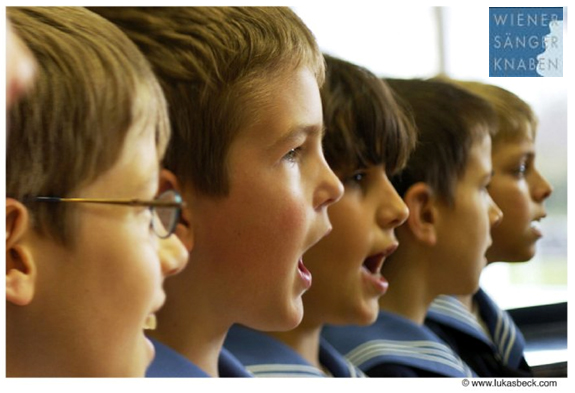
Q. Why do the Vienna Boys Choir wear sailor suits?
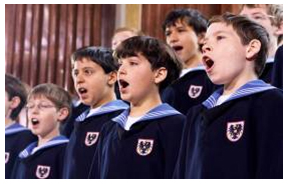
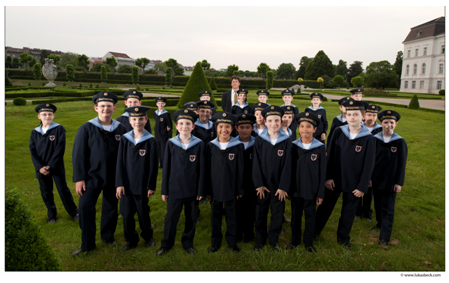
From 1498 to 1918, the Vienna Boys Choir wore uniforms designated by the Austrian court. After the fall of the court and the onset of contemporary society, the Choir took on its current title and began wearing the Academy’s uniform. They wore these uniforms from 1900 to 1918 along with a sword. The Boys began wearing the “sailor suits” right after World War II. The “sailor” style was popular among men at the time (the fact that Disney’s Donald Duck wore it, too, testifies to this as well). The basic design has not changed much, but small details of the suits have changed over the years. The choristers are given two different uniforms - white for gala concerts and blue for official performances, tours and mass. The uniforms must be returned when the choristers leave the Choir. The Boys, however, are allowed to keep their hats as souvenirs.


BIOGRAPHY -
Wiener Sangerknaben / Vienna Boys Choir

The Vienna Boys' Choir is a choir of long-standing tradition; it is one of the oldest boys' choirs not attached to a church or a college. It was the choir attached to the Austrian court (and very much a travelling band); its roots go back to the 13th century, but records from the early phases are tenuous and scarce. In the late 15th century, the choir was part of the court music of Maximilian I, the Holy Roman Emperor, who moved the court from Innsbruck to Vienna and thus is credited with the foundation of the Chapel Imperial.

Among the Choir's duties today are the Sunday services in the Imperial Chapel, appearances at official state occasions, concerts in Vienna and abroad as well as appearances in the Vienna State Opera and Volksoper. Each choir spends about 11 weeks of the academic year on tour; each choir boy sings around 80 performances a year.

The Augartenpalais was built in 1692 for Zacharias Leeb, a merchant and city councillor. Plans for the palace were probably by Johann Bernhard Fischer von Erlach, one of the most famous architects of the day.

In 1780, Emperor Joseph II bought it as a hunting lodge. Joseph, who had frugal tastes and thought the palace frivolous, had the "Josephstockel" built at the back of the building, smaller and perhaps for him more practical. Today, the Josephstockel houses the Choir's kindergarten and primary school.

In the 19th century, a salon opened in the palace; among its guests were Johannes Brahms, Franz Liszt, Richard Wagner and Hans Makart.

In 1873, a feast was held at the palace as part of the Vienna World Exhibition, with Emperor Franz Joseph I and Tsar Alexander II present.

In 1897, the family of archduke Otto moved into the palace; from 1934 to 1936 it was the residence of the Austrian chancellor Kurt Schuschnigg. The Palace sustained substantial damage in World War II. In 1948, the government gave it to the Vienna Boys' Choir who renovated it with the monies made during their 1948 tour of the USA.


http://www.wsk.at

Haydnchoir

Choirmaster Kerem Sezen
Prefects: Kerstin Mader and Mag. Johann Vergendo

Currently, Haydnchor has 24 singers, four of them have just joined, the others are seasoned troopers. This makes Haydnchor the oldest of the four groups (their prefects are debating ordering crutches and walkers for some). They are a mixed bunch indeed, coming from Vienna, Lower Austria, Styria, Salzburg, from Germany, Slovakia, France, Hungary, Japan and the USA. Among the languages spoken are Slovak, Czech, Hungarian, Japanese, Turkish, French and English as well as Latin which comes in handy if you want to listen to Radio Vatican. Or indeed sing a motet. Haydnchor boasts also the Vienna Boys' Choir's only set of twins (and is planning to have more twins next year. Triplets would also be interesting). We live in hope that the other choristers will be able to distinguish them in years to come.

2011 Program

Carl Orff (1895 - 1982)
O Fortuna / Fortuna Imperatrix Mundi (Fortune, Empress of the world),
from: Carmina burana

Johann Sebastian Bach (1685 - 1750)
Wer Gott bekennt aus wahrem Herzensgrund (Who acknowledges God wholeheartedly),
from cantata BWV 45 ’Es ist dir gesagt, Mensch, was gut ist’

Giovanni Pierluigi da Palestrina (~1525 - 1594)
Adoramus te Christe (We praise you, Christ)

Anton Bruckner (1824 - 1896)
Virga Jesse (The Rod of Jesse), WAB 52 (1885)

Gabriel Faure (1845 - 1924)
Ave verum corpus (Hail, true body), op. 65/1 (1894)
Motet for two equal voices and organ

Arthur Bliss (1891 - 1975)
Prayer of Saint Francis of Assisi, F. 47 (1972)

Anton Heiller (1923 - 1979)
Ave Maria (Hail Mary), for boys’ choir a capella (1957)

Giovanni Battista Pergolesi (1710 - 1736)
Four pieces from Stabat mater

-Intermission-

Wolfram Wagner (b. 1962)
Mr. Double Bass (2010) for boys’ choir, double bass, and piano
Text: Hahnrei Wolf Kafer (b. 1948)

Zoltan Kodaly (1882 - 1967)
Enek Szent Istvan kiralyhoz (Hymn to King Saint Stephen, 1938)
Bozoky Songbook

Johannes Brahms (1833 - 1897)
Und gehst du uber den Kirchhof (And if you cross the churchyard),
from: ’Jungbrunnen’ (Fountain of Youth) op. 44 /10
Text: Paul Heyse (1830 - 1914)

Engelbert Humperdinck (1854 - 1921)
Abendsegen (Evening prayer), from the opera ’Hansel und Gretel’ EHWV 93
Text: Adelheid Wette (1858 - 1916) and Hermann Wette (1857 - 1919)
Arr. for three-part choir Friedrich Zipp (1914 - 1997)

Franz Schubert (1797 - 1828)
Im Abendrot (At sunset), D 799 (1825)
Text: Karl Gottlieb Lappe (1773 - 1843); Arr. Jakob Christ

Bruno Coulais (b. 1954)
From the motion picture ’Les choristes’ (2004):
Caresse sur l´ocean (Sea breeze)
Cerf-volant (Kite)

Philip Norman (b. 1953)
The Earth We Share, from the musical “Footrot Flats” (1983)
Lyrics: Alan Keith Grant (1941 - 2000). Vocal descant by Robert Auburn (2005)

Michael Jackson (1958 - 2009), Lionel Ritchie (b. 1949)
We Are the World (1985)

Der Mai ist gekommen (May has arrived)
Text: Emanuel Geibel 1841, Music: Justus Wilhelm Lyra (1822 - 1882)

Yodelling song from Austria

Johann Strauss jr. (1825 - 1899) and Josef Strauss (1827 - 1870)
Pizzicato Polka op. 234 (1869)

Josef Strauss (1827 - 1870)
Dorfschwalben aus Osterreich (Village swallows from Austria). Waltz, opus 164 (1864)
Text: Klemens Dorn (1874 - 1948); Arr. Victor Keldorfer

** The above program is subject to change without notice.


DISCOGRAPHY

Carols, Johann Strauss, Pergolesi (Pavilion Records  PAST CD 7082, CD)
Die Wiener Sangerknaben - Portrait (Philips  PHIL 434 726, CD)
Popular Songs and Duets by Great Masters (Philips PHCP 10603, CD)
The Wiener Sangerknaben (Philips  N 00694 R, LP)
Mozart: Bastien und Bastienne (Philips 420 163-2, LP) 1986
Mahler: Symphony No. 4 (Stradivari Classics  SCD-6050, CD) 1988
Wiener Sangerknaben - Exultate Jubilate (Philips PHIL 630 727, CD) 1991
Sing Johann Strauss Waltzes & Polkas (RCA Victor 661235, CD) July 1992
The Vienna Boys Choir - Sacred Songs (Philips  438 871, CD) 1995
Handel: Messiah Highlights (Delta 12948, CD) 1997
500 Jahre Wiener Sangerknaben (Koch Classics 3-6563-2, CD) October 1998


Angelic Voices - Best of Vienna Boys' Choir
(Polygram 462 778, CD) January 1999

Amazing Grace (Koch , CD) September 2000
Tritsch Tratsch: Live Recording of a concert in Tokyo in July 2000 (Toshiba EMI East world, CD)
Volkslieder / Folk Songs ( 325130, CD) August 2002


Vienna Boys Choir Goes Pop (EMI Classics 724355736727, CD) September 2002


Beethoven, Mozart, Haydn (Koch Universal , CD) November 2003


The Wiener Sangerknaben Goes Christmas ( , CD) November 2003


Vienna Boys Choir Best 2004 (EMI ,CD) April 2004

Christmas Voices & Bells (,CD)October 2005


I am from Austria 2007 (Universal , CD) April 2007


Amazing graze 2007 (Universal , CD)

-Compilation Albums
Voices of Angels (Teldec 4509 93705, CD) 1993
World Of Boy Soprano (PolyGram K.K. (London) POCL 4373, CD) 1996
Thirtheenth Floor, The (Milan 69216-2, CD) 1999
Les plus belles chorales d'enfants (Virgin Classics (EMI Music France) 7 24358 61472 5, CD) July 2004

-DVD
L'Or des Anges (King's Group , DVD) 1998

Venue & Seating Chart

Seoul Arts Center
2406 , Nambusunhwan-ro , Seocho-gu , Seoul
1668-1352
http://www.sac.or.kr

2011 Vienna Boys Choir New Year's Concert

2011 Vienna Boys Choir New Year's Concert

Date/Time
Jan 22, 2011
Genre
Family
Venue
Seoul Arts Center, Concert Hall
Age group
over 7 years old
Run time
2 hr (Intermission 15 min)
  • Stray Kids
  • SEVETEEN
  • Stray Kids
  • SEVETEEN
1/2
Untitled Document

JUMP-START the New Year with the Vienna Boys Choir
2011 Vienna Boys Choir New Year’s Concert


Pump up for the New Year with the heavenly voices of the Vienna Boys Choir!
Witness the serenity, tradition and poise
of the world’s oldest and best known boys choir!
Light up 2011 with family and friends with the Vienna Boys Choir New Year’s Concert!


* Date: Saturday, January 22, 2011
* Time: 8 PM
* Artist: The Vienna Boys Choir Haydnchor, Conductor: Kerem Sezen
* Program: Medieval church music, Austrian favorites, Motion Picture Soundtracks, Pop and more
* Booking: Club BALCONY -> 02-1577-5266


** For More Information, please contact EJ Cho (02-318-4301), CREDIA


1. The world’s oldest Boys Choir, boasting a history of 500 years and a music education system built on culture and tradition!
2. The best New Year’s outing for your family!
3. Presented by the Haydnchor, praised by fans as the best team of all four of Vienna Boys Choirs!


The Vienna Boys Choir in Seoul

The Vienna Boys Choir, backed by a history of 500 years as well as the courtly tradition of the Austrian royalty, comes to Korea again to open the New Year with their heavenly voices. Having had masters like Schubert and Haydn as members of the choir, Beethoven to accompany their singing, Wagner, Liszt, and Johann Strauss to dedicate works specifically written form them, the Vienna Boys Choir stands at the top of the world of choral music and will be here in January to dazzle the Korean audience once again.

Established and supported by the Austrian government and other private foundations for over a century, the Vienna Boys Choir is trained through a disciplined music education system. Representing this special training, the Choir will sing a repertoire ranging from medieval church music to modern Pop. Covering hundreds of years and a great variety of genres, the Vienna Boys Choir will mark the best of all New Years events for family and friends.

Since their first visit to Korea in 1978, the Choir has been presenting annual concerts in Korea for the last half a decade and has established its ground among Korean audiences. With the harmonious voices of the Vienna Boys Choir, 2011 begins.


“All About the Vienna Boys Choir”

Q. How many members are in the Vienna Boys Choir?
Approximately 100 members are in the Vienna Boys Choir. 102 as of June, 2006.

Q. How old are the boys?
Those who participate as choristers are between the ages of 10 and 14.

Q. How many choirs make up the Vienna Boys Choir?
The Vienna Boys' Choir is divided into four sub-groups or touring choirs. The choirs are of equal standing; the tours, appearances in Vienna and recording projects are shared among them. Each choir has a choirmaster, and two tutors or prefects who travel with the boys.
The choirs are named after famous Austrian composers associated with the choir's history, Bruckner, Haydn, Mozart and Schubert. The choir still performs much of their music.

Q. How are the four touring choirs different?
They are not different. They go overseas to perform and sing at church on weekends. However, they do have distinct voices as different members of the group project their unique sound. One can hear the difference in the sound of the choirs from the Vienna Boys Choir 1930’s recording and that recorded in 2003 as well.

Q. How many concerts does the Vienna Boys Choir perform every year?
The Boys perform about 300 concerts internationally.

Q. When was the first time they were in Korea?
In 1978, when the Vienna Boys Choir performed at the Sejong Center for the Perfroming Arts.

Q. Why do the Vienna Boys Choir wear sailor suits?
From 1498 to 1918, the Vienna Boys Choir wore uniforms designated by the Austrian court. After the fall of the court and the onset of contemporary society, the Choir took on its current title and began wearing the Academy’s uniform. They wore these uniforms from 1900 to 1918 along with a sword. The Boys began wearing the “sailor suits” right after World War II. The “sailor” style was popular among men at the time (the fact that Disney’s Donald Duck wore it, too, testifies to this as well). The basic design has not changed much, but small details of the suits have changed over the years. The choristers are given two different uniforms - white for gala concerts and blue for official performances, tours and mass. The uniforms must be returned when the choristers leave the Choir. The Boys, however, are allowed to keep their hats as souvenirs.


BIOGRAPHY -
Wiener Sangerknaben / Vienna Boys Choir

The Vienna Boys' Choir is a choir of long-standing tradition; it is one of the oldest boys' choirs not attached to a church or a college. It was the choir attached to the Austrian court (and very much a travelling band); its roots go back to the 13th century, but records from the early phases are tenuous and scarce. In the late 15th century, the choir was part of the court music of Maximilian I, the Holy Roman Emperor, who moved the court from Innsbruck to Vienna and thus is credited with the foundation of the Chapel Imperial.

Among the Choir's duties today are the Sunday services in the Imperial Chapel, appearances at official state occasions, concerts in Vienna and abroad as well as appearances in the Vienna State Opera and Volksoper. Each choir spends about 11 weeks of the academic year on tour; each choir boy sings around 80 performances a year.

The Augartenpalais was built in 1692 for Zacharias Leeb, a merchant and city councillor. Plans for the palace were probably by Johann Bernhard Fischer von Erlach, one of the most famous architects of the day.

In 1780, Emperor Joseph II bought it as a hunting lodge. Joseph, who had frugal tastes and thought the palace frivolous, had the "Josephstockel" built at the back of the building, smaller and perhaps for him more practical. Today, the Josephstockel houses the Choir's kindergarten and primary school.

In the 19th century, a salon opened in the palace; among its guests were Johannes Brahms, Franz Liszt, Richard Wagner and Hans Makart.

In 1873, a feast was held at the palace as part of the Vienna World Exhibition, with Emperor Franz Joseph I and Tsar Alexander II present.

In 1897, the family of archduke Otto moved into the palace; from 1934 to 1936 it was the residence of the Austrian chancellor Kurt Schuschnigg. The Palace sustained substantial damage in World War II. In 1948, the government gave it to the Vienna Boys' Choir who renovated it with the monies made during their 1948 tour of the USA.


http://www.wsk.at

Haydnchoir

Choirmaster Kerem Sezen
Prefects: Kerstin Mader and Mag. Johann Vergendo

Currently, Haydnchor has 24 singers, four of them have just joined, the others are seasoned troopers. This makes Haydnchor the oldest of the four groups (their prefects are debating ordering crutches and walkers for some). They are a mixed bunch indeed, coming from Vienna, Lower Austria, Styria, Salzburg, from Germany, Slovakia, France, Hungary, Japan and the USA. Among the languages spoken are Slovak, Czech, Hungarian, Japanese, Turkish, French and English as well as Latin which comes in handy if you want to listen to Radio Vatican. Or indeed sing a motet. Haydnchor boasts also the Vienna Boys' Choir's only set of twins (and is planning to have more twins next year. Triplets would also be interesting). We live in hope that the other choristers will be able to distinguish them in years to come.

2011 Program

Carl Orff (1895 - 1982)
O Fortuna / Fortuna Imperatrix Mundi (Fortune, Empress of the world),
from: Carmina burana

Johann Sebastian Bach (1685 - 1750)
Wer Gott bekennt aus wahrem Herzensgrund (Who acknowledges God wholeheartedly),
from cantata BWV 45 ’Es ist dir gesagt, Mensch, was gut ist’

Giovanni Pierluigi da Palestrina (~1525 - 1594)
Adoramus te Christe (We praise you, Christ)

Anton Bruckner (1824 - 1896)
Virga Jesse (The Rod of Jesse), WAB 52 (1885)

Gabriel Faure (1845 - 1924)
Ave verum corpus (Hail, true body), op. 65/1 (1894)
Motet for two equal voices and organ

Arthur Bliss (1891 - 1975)
Prayer of Saint Francis of Assisi, F. 47 (1972)

Anton Heiller (1923 - 1979)
Ave Maria (Hail Mary), for boys’ choir a capella (1957)

Giovanni Battista Pergolesi (1710 - 1736)
Four pieces from Stabat mater

-Intermission-

Wolfram Wagner (b. 1962)
Mr. Double Bass (2010) for boys’ choir, double bass, and piano
Text: Hahnrei Wolf Kafer (b. 1948)

Zoltan Kodaly (1882 - 1967)
Enek Szent Istvan kiralyhoz (Hymn to King Saint Stephen, 1938)
Bozoky Songbook

Johannes Brahms (1833 - 1897)
Und gehst du uber den Kirchhof (And if you cross the churchyard),
from: ’Jungbrunnen’ (Fountain of Youth) op. 44 /10
Text: Paul Heyse (1830 - 1914)

Engelbert Humperdinck (1854 - 1921)
Abendsegen (Evening prayer), from the opera ’Hansel und Gretel’ EHWV 93
Text: Adelheid Wette (1858 - 1916) and Hermann Wette (1857 - 1919)
Arr. for three-part choir Friedrich Zipp (1914 - 1997)

Franz Schubert (1797 - 1828)
Im Abendrot (At sunset), D 799 (1825)
Text: Karl Gottlieb Lappe (1773 - 1843); Arr. Jakob Christ

Bruno Coulais (b. 1954)
From the motion picture ’Les choristes’ (2004):
Caresse sur l´ocean (Sea breeze)
Cerf-volant (Kite)

Philip Norman (b. 1953)
The Earth We Share, from the musical “Footrot Flats” (1983)
Lyrics: Alan Keith Grant (1941 - 2000). Vocal descant by Robert Auburn (2005)

Michael Jackson (1958 - 2009), Lionel Ritchie (b. 1949)
We Are the World (1985)

Der Mai ist gekommen (May has arrived)
Text: Emanuel Geibel 1841, Music: Justus Wilhelm Lyra (1822 - 1882)

Yodelling song from Austria

Johann Strauss jr. (1825 - 1899) and Josef Strauss (1827 - 1870)
Pizzicato Polka op. 234 (1869)

Josef Strauss (1827 - 1870)
Dorfschwalben aus Osterreich (Village swallows from Austria). Waltz, opus 164 (1864)
Text: Klemens Dorn (1874 - 1948); Arr. Victor Keldorfer

** The above program is subject to change without notice.


DISCOGRAPHY

Carols, Johann Strauss, Pergolesi (Pavilion Records  PAST CD 7082, CD)
Die Wiener Sangerknaben - Portrait (Philips  PHIL 434 726, CD)
Popular Songs and Duets by Great Masters (Philips PHCP 10603, CD)
The Wiener Sangerknaben (Philips  N 00694 R, LP)
Mozart: Bastien und Bastienne (Philips 420 163-2, LP) 1986
Mahler: Symphony No. 4 (Stradivari Classics  SCD-6050, CD) 1988
Wiener Sangerknaben - Exultate Jubilate (Philips PHIL 630 727, CD) 1991
Sing Johann Strauss Waltzes & Polkas (RCA Victor 661235, CD) July 1992
The Vienna Boys Choir - Sacred Songs (Philips  438 871, CD) 1995
Handel: Messiah Highlights (Delta 12948, CD) 1997
500 Jahre Wiener Sangerknaben (Koch Classics 3-6563-2, CD) October 1998


Angelic Voices - Best of Vienna Boys' Choir
(Polygram 462 778, CD) January 1999

Amazing Grace (Koch , CD) September 2000
Tritsch Tratsch: Live Recording of a concert in Tokyo in July 2000 (Toshiba EMI East world, CD)
Volkslieder / Folk Songs ( 325130, CD) August 2002


Vienna Boys Choir Goes Pop (EMI Classics 724355736727, CD) September 2002


Beethoven, Mozart, Haydn (Koch Universal , CD) November 2003


The Wiener Sangerknaben Goes Christmas ( , CD) November 2003


Vienna Boys Choir Best 2004 (EMI ,CD) April 2004

Christmas Voices & Bells (,CD)October 2005


I am from Austria 2007 (Universal , CD) April 2007


Amazing graze 2007 (Universal , CD)

-Compilation Albums
Voices of Angels (Teldec 4509 93705, CD) 1993
World Of Boy Soprano (PolyGram K.K. (London) POCL 4373, CD) 1996
Thirtheenth Floor, The (Milan 69216-2, CD) 1999
Les plus belles chorales d'enfants (Virgin Classics (EMI Music France) 7 24358 61472 5, CD) July 2004

-DVD
L'Or des Anges (King's Group , DVD) 1998

Price

More detailed ticket information will be available when you book the tickets.

Venue & Seating Chart

Seoul Arts Center
2406 , Nambusunhwan-ro , Seocho-gu , Seoul
1668-1352
http://www.sac.or.kr


2011 Vienna Boys Choir New Year's Concert | NOL World