
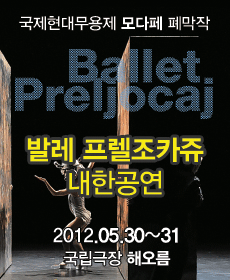
BALLET PRELJOCAJ 〈And then, one thousand years of peace〉
- Date/Time
- May 30, 2012 - May 31, 2012
- Genre
- Dance
- Venue
- The National Theater of Korea, Main Hall HaeView Venue Info
- Age group
- All
- Run time
- 1 hr 40 min
Price


BALLET PRELJOCAJ Since founding his company in december 1984, Angelin Preljocaj has created 45 choreographic works, ranging from solo to larger formations. He has multiplied his collaborations with other artists like Enki Bilal, Air, Granular Synthesis, Fabrice Hyber, Karlheinz Stockhausen, Jean Paul Gaultier and Constance Guisset… His creations have been restaged by numerous other repertory companies, from which he also receives requests to create new pieces. This has been the case with La Scala in Milan, the New York City Ballet, the Staatsoper in Berlin and the Paris Opera Ballet. The Ballet Preljocaj now has 26 permanent dancers. As well as performing the repertoire of Angelin Preljocaj throughout the world, the Ballet Preljocaj has increased its activities in Aix-en-Provence and the surrounding region in order to allow the greatest possible number of people to discover dance. In October 2006, the Ballet Preljocaj moved into new premises designed by the architect Rudy Ricciotti: the Pavillon Noir is the first purpose-built production centre in which the artists can carry out the entire process of creation, from the work in the studio to the performance on stage. The Theatre and the four studios offer dance shows and encounters all the year round, created both by Angelin Preljocaj and by guest companies.
And then, one thousand years of peace Working within a poetic and impressionist vein, And then, one thousand years of peace relies on an assiduous but not irrational reading of the Apocalypse. One should thus refrain from looking for images or cliches that illustrate, directly or referentially, Saint John's famous text. Every choreography is like a metaphorical treasure hunt ; an enigma that is solved by considering what each individual element is going to contribute to the piece as a whole. There is Subodh Gupta, the Indian artist, with his fascination for objects that shape cultural identity. He is creating the set and makes use of the gleaming gaudiness of Indian ustensils, manipulating them to express the ambivalent sense of belonging that they evoke. In other words, he takes everyday objects and transforms them into cult objects of worship. Then there is Laurent Garnier, who will be musical director and is a leading name in the genre of techno music, which gives an air of trance back to musical performance, imbuing it with a sense of modern ritual and avant-garde ceremony with ancient roots. This gathering of young talent emanates a curious aura of modern ritual and has in common a way of steeping our modern era in the most ancient of collective beliefs, an approach which is not entirely new to Angelin Preljocaj. A nos heros (1986) mocked a less-than-firm ≪ fist in the air ≫ attitude and faith in political mythology. Hallali Romee (1987) portrayed Joan of Arc, in a stark and impassive way and as an unconventional heroine. As for Annonciation (1995), this was full of highly ambiguous symbolism. And the extreme religious atmosphere created, not without irony by Stockhausen, in his opus Sonntags Abschied was interpreted in the choreography of Eldorado (2007) as a godless ritual. So, when Angelin Preljocaj declares that he wants to work on a new creation about the Apocalypse, we should perhaps first recall what the word (from ≪ apo ≫, dare and ≪ kaly-ptein ≫, the sail) actually means: dare to reveal. It would seem, therefore, that the essence of Angelin Preljocajs latest creation is his desire to reveal what is concealed behind our modern rituals.
Angelin Preljocaj was born in the Paris region of France, and began studying classical ballet before turning to contemporary dance, which he studied with Karin Waehner. In 1980, he went to New York to work with Zena Rommett and Merce Cunningham, after which he resumed his studies in France, where his teachers included the American choreographer Viola Farber and the French Quentin Rouillier. After that he joined Dominique Bagouet before founding his own company in December 1984. Angelin Preljocaj works regularly with other artists including Enki Bilal (Romeo et Juliette, 1990), Goran Vejvoda (Paysage apres la bataille, 1997), Air (Near Life Experience, 2003), Granular Synthesis (“N”, 2004), Fabrice Hyber (Les 4 saisons…, 2005), Karlheinz Stockhausen (Eldorado - Sonntags Abschied, 2007), Jean Paul Gaultier (Snow White, 2008), Constance Guisset (Le funambule, 2009), Claude Leveque (Siddharta, 2010) or Laurent Garnier and Subodh Gupta (And then, one thousand years of peace, 2010). His productions have become part of the repertoire of many companies which also offer him commissions, notably La Scala of Milan, the New York City Ballet and the Paris Opera Ballet. He has made short films (Le postier, Idees noires in 1991) and several full-length films, notably Un trait d-union and Annonciation (1992 and 2003) and for which he was awarded the “Grand Prix du Film d-Art” in 2003, the “Video-Danse” First Prize in 1992 and the Prague Video Festival Prize in 1993. Since then he has collaborated on several films presenting his own choreographic work: Les Raboteurs with Cyril Collard after the painting by Gustave Caillebotte in 1988, Pavillon Noir withPierre Coulibeuf in 2006, Eldorado/ Preljocaj with Olivier Assayas in 2007 and Snow White en 2009.Several books have been written about his work, notably Angelin Preljocaj in 2003, Pavillon Noir in2006 and Angelin Preljocaj, Topologie de l-invisible in 2008. In the course of his career, Angelin Preljocaj has received a number of awards, including the “Grand Prix National de la Danse” awarded by the French Ministry of Culture in 1992, the “Benois de la danse” for Le Parc in 1995, the “Bessie Award” for Annonciation in 1997, “Les Victoires de la musique” for Romeo et Juliette in 1997, the “Globe de Cristal” for Snow White in 2009. He is an “Officier des Arts et des Lettres”, a “Chevalier de la Legion d-honneur” and he was appointed an “Officier de l-ordre du Merite” in May 2006. Since October 2006, the Ballet Preljocaj and its 26 permanent dancers are installed in the Pavillon Noir in Aix-en-Provence, a building entirely dedicated to dance, with Angelin Preljocaj as its artistic director. |
Venue & Seating Chart
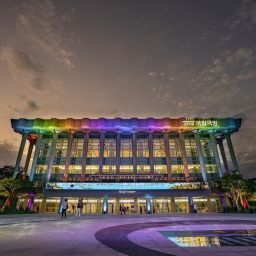
- 59 , Jangchungdan-ro , Jung-gu , Seoul
- 02-2280-4115~6
- http://www.ntok.go.kr/
BALLET PRELJOCAJ 〈And then, one thousand years of peace〉
- Date/Time
- May 30, 2012 - May 31, 2012
- Genre
- Dance
- Venue
- The National Theater of Korea, Main Hall HaeView Venue Info
- Age group
- All
- Run time
- 1 hr 40 min
BALLET PRELJOCAJ Since founding his company in december 1984, Angelin Preljocaj has created 45 choreographic works, ranging from solo to larger formations. He has multiplied his collaborations with other artists like Enki Bilal, Air, Granular Synthesis, Fabrice Hyber, Karlheinz Stockhausen, Jean Paul Gaultier and Constance Guisset… His creations have been restaged by numerous other repertory companies, from which he also receives requests to create new pieces. This has been the case with La Scala in Milan, the New York City Ballet, the Staatsoper in Berlin and the Paris Opera Ballet. The Ballet Preljocaj now has 26 permanent dancers. As well as performing the repertoire of Angelin Preljocaj throughout the world, the Ballet Preljocaj has increased its activities in Aix-en-Provence and the surrounding region in order to allow the greatest possible number of people to discover dance. In October 2006, the Ballet Preljocaj moved into new premises designed by the architect Rudy Ricciotti: the Pavillon Noir is the first purpose-built production centre in which the artists can carry out the entire process of creation, from the work in the studio to the performance on stage. The Theatre and the four studios offer dance shows and encounters all the year round, created both by Angelin Preljocaj and by guest companies.
And then, one thousand years of peace Working within a poetic and impressionist vein, And then, one thousand years of peace relies on an assiduous but not irrational reading of the Apocalypse. One should thus refrain from looking for images or cliches that illustrate, directly or referentially, Saint John's famous text. Every choreography is like a metaphorical treasure hunt ; an enigma that is solved by considering what each individual element is going to contribute to the piece as a whole. There is Subodh Gupta, the Indian artist, with his fascination for objects that shape cultural identity. He is creating the set and makes use of the gleaming gaudiness of Indian ustensils, manipulating them to express the ambivalent sense of belonging that they evoke. In other words, he takes everyday objects and transforms them into cult objects of worship. Then there is Laurent Garnier, who will be musical director and is a leading name in the genre of techno music, which gives an air of trance back to musical performance, imbuing it with a sense of modern ritual and avant-garde ceremony with ancient roots. This gathering of young talent emanates a curious aura of modern ritual and has in common a way of steeping our modern era in the most ancient of collective beliefs, an approach which is not entirely new to Angelin Preljocaj. A nos heros (1986) mocked a less-than-firm ≪ fist in the air ≫ attitude and faith in political mythology. Hallali Romee (1987) portrayed Joan of Arc, in a stark and impassive way and as an unconventional heroine. As for Annonciation (1995), this was full of highly ambiguous symbolism. And the extreme religious atmosphere created, not without irony by Stockhausen, in his opus Sonntags Abschied was interpreted in the choreography of Eldorado (2007) as a godless ritual. So, when Angelin Preljocaj declares that he wants to work on a new creation about the Apocalypse, we should perhaps first recall what the word (from ≪ apo ≫, dare and ≪ kaly-ptein ≫, the sail) actually means: dare to reveal. It would seem, therefore, that the essence of Angelin Preljocajs latest creation is his desire to reveal what is concealed behind our modern rituals.
Angelin Preljocaj was born in the Paris region of France, and began studying classical ballet before turning to contemporary dance, which he studied with Karin Waehner. In 1980, he went to New York to work with Zena Rommett and Merce Cunningham, after which he resumed his studies in France, where his teachers included the American choreographer Viola Farber and the French Quentin Rouillier. After that he joined Dominique Bagouet before founding his own company in December 1984. Angelin Preljocaj works regularly with other artists including Enki Bilal (Romeo et Juliette, 1990), Goran Vejvoda (Paysage apres la bataille, 1997), Air (Near Life Experience, 2003), Granular Synthesis (“N”, 2004), Fabrice Hyber (Les 4 saisons…, 2005), Karlheinz Stockhausen (Eldorado - Sonntags Abschied, 2007), Jean Paul Gaultier (Snow White, 2008), Constance Guisset (Le funambule, 2009), Claude Leveque (Siddharta, 2010) or Laurent Garnier and Subodh Gupta (And then, one thousand years of peace, 2010). His productions have become part of the repertoire of many companies which also offer him commissions, notably La Scala of Milan, the New York City Ballet and the Paris Opera Ballet. He has made short films (Le postier, Idees noires in 1991) and several full-length films, notably Un trait d-union and Annonciation (1992 and 2003) and for which he was awarded the “Grand Prix du Film d-Art” in 2003, the “Video-Danse” First Prize in 1992 and the Prague Video Festival Prize in 1993. Since then he has collaborated on several films presenting his own choreographic work: Les Raboteurs with Cyril Collard after the painting by Gustave Caillebotte in 1988, Pavillon Noir withPierre Coulibeuf in 2006, Eldorado/ Preljocaj with Olivier Assayas in 2007 and Snow White en 2009.Several books have been written about his work, notably Angelin Preljocaj in 2003, Pavillon Noir in2006 and Angelin Preljocaj, Topologie de l-invisible in 2008. In the course of his career, Angelin Preljocaj has received a number of awards, including the “Grand Prix National de la Danse” awarded by the French Ministry of Culture in 1992, the “Benois de la danse” for Le Parc in 1995, the “Bessie Award” for Annonciation in 1997, “Les Victoires de la musique” for Romeo et Juliette in 1997, the “Globe de Cristal” for Snow White in 2009. He is an “Officier des Arts et des Lettres”, a “Chevalier de la Legion d-honneur” and he was appointed an “Officier de l-ordre du Merite” in May 2006. Since October 2006, the Ballet Preljocaj and its 26 permanent dancers are installed in the Pavillon Noir in Aix-en-Provence, a building entirely dedicated to dance, with Angelin Preljocaj as its artistic director. |
Price
Venue & Seating Chart
- 59 , Jangchungdan-ro , Jung-gu , Seoul
- 02-2280-4115~6
- http://www.ntok.go.kr/