NOL World
Account
Daniel Barenboim & The West-Eastern Divan Orchestra Peace Concert
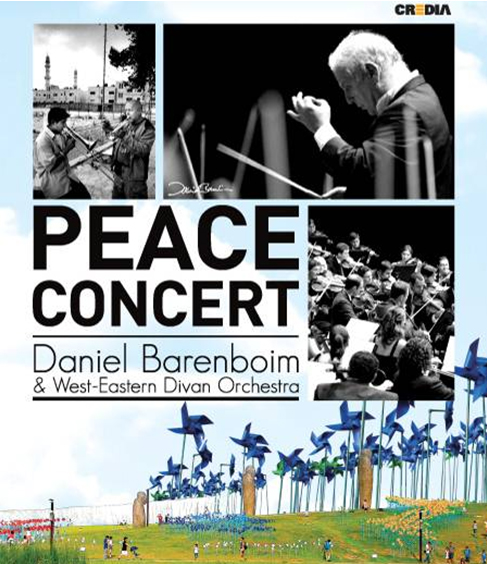
Daniel Barenboim & The West-Eastern Divan Orchestra Peace Concert

Date/Time
Aug 15, 2011
Genre
Classic
Venue
Iimjingak Pyeonghoa-Nuri Park
Age group
5 years and over
Run time
1 hr 20 min

Price

More detailed ticket information will be available when you book the tickets.
1/3
Untitled Document

Daniel Barenboim & The West-Eastern Divan Orchestra Peace Concert


Date, Time and Venue

August 15, 2011 at 7 PM, Outdoor Performance Hall, Imjingak Pyeonghoa-Nuri

Program: Beethoven Symphony No. 9

Artists:
Daniel Barenboim (Conductor), West-Eastern Divan Orchestra
Soprano Sumi Jo, Mezzo Soprano Ah-Kyung Lee,
Tenor Ji-Min Park, Bass Maurice Hamm
United Choir (National Chorus, Goyang City Choir, Seoul Motet Choir)

Tickets: Picnic seat - 35,000 won (seating mats provided) , 20% discount on all purchases above 3


A Melody of Miracle to Resonate Through DMZ!

A Must-See Concert by Barenboim, Sumi Jo and the West-Eastern Divan Orchestra
- A Musical Message of Peace
On August 15 (7 PM) the legendary pianist and conductor Daniel Barenboim will stand before an audience comprising citizens of the only remaining divided state in the world in the demilitarized zone of the Korean peninsula. Barenboim will deliver a message of peace through the music he will present with the West-Eastern Divan Orchestra and South Korean soloists including the superstar soprano Sumi Jo. The concert will carry special significance as it will take place on the grounds of the Cold War’s last frontier featuring not only the Maestro himself, but also an orchestra which consists of young musicians from the world’s most concentrated area of conflict - Israel, Palestine and several Arab countries. As soloists Sumi Jo, a Diva Soprano celebrated both domestically and abroad, Ah-Kyung Lee, a Mezzo Soprano highly praised by classical music fans for her remarkable talent, Ji-Min Park, a rising-star Tenor of the Royal Opera of Great Britain, and Maurice Hamm, a Bass singer described by critics as a hidden treasure will appear on stage with the orchestra and conductor.

The Hottest Issue in Culture, Diplomacy, and Politics of the Global Community of 2011!
A Concert on August 15, National Independence Day, to Resound Harmony throughout the DMZ!
On August 15, Young musicians from Israel, Palestine and several Arab countries - an area struck with constant conflict caused by ideological differences - will gather under the name of West-Eastern Divan Orchestra to perform Beethoven Symphony No. 9, also known as ‘Ode to Joy’ at Imjingak Pyeonghwa-Nuri. A grassy field bordering the demilitarized zone between North and South Korea, the location of the concert along with the date of the event signify the underlying message of the event - to emphasize the importance of peace by commemorating Korea’s independence from Japanese colonization and the end of World War II.
The concert, which will take place in the world’s only remaining divided state at a time when tension between the two Koreas has heightened due to recent clashes, will revive the miraculous and moving memory of the performance in 2005 by the same orchestra and conductor at Ramallah, Palestine, an area also agitated by political divide.
On August 15, 2011, the world will witness yet another miracle that will touch the hearts of audiences the world over.

A Performance of Symphony No.9 by Beethoven, the Most Beloved Composer in Korea & Sumi-Jo, Korea’s Favorite Soprano!
Beethoven, the most beloved composer among Korean audiences is also a special name in the musical career of Barenboim. As a pianist Barenboim recorded the full cycle of Beethoven’s piano sonatas and rose to the top of the world’s classical music scene. In his upcoming concert in Korea, he will deliver one of Beethoven’s most familiar works as the conductor of an orchestra he co-founded with the Palestinian-American scholar Edward Said. The fact that the concert will present a work which Beethoven completed despite his hearing loss delivers a message of joy and hope in itself.
Beethoven Symphony No. 9 performed by the West-Eastern Divan Orchestra under the baton of Daniel Barenboim and the world-class soprano Sumi Jo on the hill of Imjingak Pyeonghwa-Nuri will send a message of peace throughout the international community. With the fourth movement of the Symphony will begin the ‘Ode to Joy’ filled with the lively and festive mood characteristic of its melody. As the vocals meet the sound of the instruments the music will come together and lead the audience and artists to unite as if to reflect the lyrics of the movement which reads “all men will become brothers.” And as the words of the refrain suggest, the music of the joyful Symphony resonating through Imjingak will bring audiences of the world together to “be embraced, [as] millions!” under consolidated hope of bringing peace and harmony to the peninsula and beyond.

PROFILE

Daniel Barenboim Conductor

Daniel Barenboim is one of the few musicians in the world today who could accurately be described as legendary" (The Times)
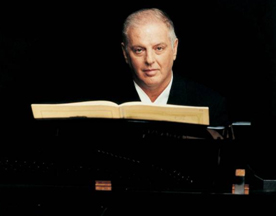
Daniel Barenboim was born in Buenos Aires in 1942 to parents of Jewish Russian descent. He started piano lessons at the age of five with his mother, continuing to study with his father who remained his only other teacher. In August 1950, when he was only seven years old, he gave his first official concert in Buenos Aires. 

Important influences in his development as a musician included Artur Rubinstein and Adolf Busch, both of whom performed in Argentina. The Barenboim family moved to Israel in 1952. Two years later, in the summer of 1954, the parents brought their son to Salzburg to take part in Igor Markevich's conducting classes. During that same summer he also met Wilhelm Furtwangler, played for him and attended some of the great conductor's rehearsals and a concert. Furtwangler subsequently wrote a letter including the words "the eleven year-old Barenboim is a phenomenon …" This phrase was to open many doors to Daniel Barenboim for a long time to come. In 1955 the young Daniel Barenboim studied harmony and composition with Nadia Boulanger in Paris.

Barenboim made his debut as a pianist in Vienna and Rome in 1952, in Paris in 1955, in London in 1956 and in New York in 1957 with Leopold Stokowski and the Symphony of the Air. From then on, he made annual concert tours of the United States and Europe. He toured Australia in 1958 and soon became known as one of the most versatile pianists of his generation.

He made his first gramophone recordings in 1954 and soon began recording the most important works in the piano repertoire, including complete piano sonatas cycles of Mozart and Beethoven and concerto cycles of Mozart, Beethoven (with Otto  Klemperer), Brahms (with Sir John Barbirolli) and Bartok (with Pierre Boulez).
During the same period, Barenboim began to devote more time to conducting. His close relationship with the English Chamber Orchestra which began in 1965 lasted over a decade. During this time they performed frequently in England with Barenboim as both conductor and piano soloist and went on tour in Europe, the United States, Japan, Australia and New Zealand. Following his conducting debut with the New Philharmonia Orchestra in London in 1967, Barenboim began to conduct all the leading European and American symphony orchestras. Between 1975 and 1989 he was Music Director of the Orchestre de Paris, his tenure marked by a commitment to contemporary music including works by Lutoslawski, Berio, Boulez, Henze, Dutilleux, Takemitsu and others.
Daniel Barenboim has always been active as a chamber musician, performing with, among others, cellist Jacqueline du Pre (his late wife), Gregor Piatigorsky, Itzhak Perlman and Pinchas Zukerman. Collaborations with illustrious singers have included Dietrich Fischer-Dieskau, Thomas Quasthoff, Rolando Villazon and Dorothea Roschmann. In recent years he has performed chamber music at the Jerusalem International Chamber Music Festival and with members of the Staatskapelle Berlin.
Daniel Barenboim made his opera conducting debut in 1973 with a performance of Mozart's Don Giovanni at the Edinburgh International Festival. In 1981 he made his debut at the Bayreuth Festival, where he has conducted Tristan und Isolde, the Ring cycle, Parsifal and Die Meistersinger.
In 1991 he succeeded Sir Georg Solti as Music Director of the Chicago Symphony Orchestra, with whom he enjoyed countless successes in all the world's great concert halls for fifteen years. At the conclusion of his tenure in June 2006, the CSO musicians adopted a resolution naming him "our honorary conductor for life." In 1992 he became General Music Director of the Deutsche Staatsoper Berlin (German State Opera Berlin). In the autumn of 2000, the Staatskapelle Berlin appointed him Chief Conductor for Life. 
Barenboim continues to appear as a regular guest conductor with the Berlin Philharmonic and Vienna Philharmonic orchestras. In 2006 he was named Maestro Scaligero at La Scala, Milan, where he conducted Patrice Chereau’s acclaimed production of Tristan und Isolde in December 2007. Barenboim is a prolific recording artist and has made recordings since 1954 for Westminster, EMI, Deutsche Grammophon, Decca, Philips, Sony Classical (CBS Masterworks), BMG, Erato Disques and Teldec Classics International. He has won multiple Grammy Awards over the years.

In addition to Barenboim’s indisputable musical authority, he has become increasingly vocal in non-musical issues over the years. A Jew born during the Second World War and an Israeli by nationality, he has worked closely over many years with three German orchestras - the Berlin Philharmonic, the Staatskapelle Berlin and the Bayreuth Festival Orchestra in an atmosphere of mutual affection and respect.
In the early 1990s, a chance meeting between Barenboim and the late Palestinian-born writer and Columbia University professor Edward Said in a London hotel lobby led to an intensive friendship that has had both political and musical repercussions. These two men, who should have been poles apart politically, discovered in that first meeting, which lasted for hours, that they had similar visions for the future of potential Israeli/Palestinian cooperation. They decided to continue their dialogue and to collaborate on musical events to further their shared vision of peaceful co-existence in the Middle East. This led to Barenboim's first concert on the West Bank, a piano recital at the Palestinian Birzeit University in February 1999. It also led to a workshop for young musicians from the Middle East that took place in Weimar, Germany, in August 1999: this group was to become the West-Eastern Divan Orchestra.
The West-Eastern Divan Workshop took two years to organize and involved talented young musicians between the ages of 14 and 25 from Egypt, Syria, Lebanon, Jordan, Tunisia and Israel. The idea was that they would come together to make music on neutral ground with the guidance of some of the world's best musicians. Weimar was chosen as the site for the workshop because of its rich cultural tradition of writers, poets, musicians and creative artists and because it was the 1999 European cultural capital. Barenboim wisely chose two concertmasters for the orchestra, an Israeli and a Lebanese. There were some tense moments among the young players at first, but after being coached by members of the Berlin Philharmonic, the Chicago Symphony and the Staatskapelle Berlin, and having master classes with the cellist Yo-Yo Ma and nightly cultural discussions with Said and Barenboim, the young musicians worked and played in increasing harmony.
The West-Eastern Divan Workshop was held again in Weimar in the summer of 2000 and in Chicago in the summer of 2001. It has since found a permanent home in Seville, Spain, where it has been based since 2002. Each summer, following their workshop, the West-Eastern Divan Orchestra gives public concerts; to date it has performed in Europe and North and South America, including appearances at the BBC Proms and the Edinburgh, Lucerne and Salzburg festivals. In 2005, they performed a historic concert in the Cultural Palace in Ramallah, which was broadcast on television internationally and recorded on DVD. In December 2006, the West-Eastern Divan Orchestra went to the U.S.A., performing at Carnegie Hall and ending the tour with a farewell concert at the United Nations for outgoing Secretary General Kofi Annan. In 2007, the West-Eastern Divan Orchestra was invited to be in residence at the Salzburg Festival.
Edward Said passed away in 2003 but his partnership with Daniel Barenboim lives on through the West-Eastern Divan Orchestra and through the Barenboim-Said Foundation, which promotes music and co-operation through projects targeted at young Arabs and Israelis. In January 2005, Daniel Barenboim delivered the first Edward Said Lecture at Columbia University in New York City. Said’s widow Mariam continues to actively support and work for the orchestra and the Barenboim-Said Foundation.
Mr. Barenboim is keen to draw young people to music, believing in the transformative power of music. To this end, he was instrumental in founding music kindergartens in Ramallah and Berlin in 2004 and 2005 respectively. Through the Seville-based Barenboim-Said Foundation and his own Berlin-based Barenboim Foundation, he has inspired the creation of an Early Childhood Music Education Project, a Music Education Project in the Middle East and an Academy of Orchestral Studies in Seville. Both foundations continue to support musical education in the West Bank and in Nazareth, where instrumental lessons are given at the newly opened Edward Said Conservatory, headed by Nabeel Abboud-Ashkar, a violinist from the West-Eastern Divan Orchestra. On March 28th, 2008, Barenboim gave a special concert in Jerusalem with young Israeli and Palestinian musicians on the occasion of Israel’s 60th anniversary. 

In October 2002 Daniel Barenboim and Edward Said jointly received Spain's prestigious Prince of Asturias Concord Prize for their work in founding the West-Eastern Divan Workshop. Mr. Barenboim was also named an honorary citizen of Spain. In November 2002 he was awarded the Tolerance Prize by the Protestant Academy of Tutzing, in southwestern Germany, for his efforts to bring Palestinians and Israelis together through music. The same month, the president of Germany awarded Mr. Barenboim the Grosses Bundesverdienstkreuz, the highest honor given to someone who is not a head of state. In 2004, Mr. Barenboim received the Buber-Rosenzweig Medal, the Wolf Prize for the Arts in the Knesset in Jerusalem and the Haviva Reik Peace Award. In 2005, he won the Special Ambassador of Music Prize of Echo Klassik and was named the 2006 Charles Eliot Norton Professor of Poetry at Harvard University where he delivered six lectures in autumn 2006. Also in 2006, Daniel Barenboim won the Kulturgroschen award, the Peace Prize from the Korn and Gerstenmann Foundation and the Music Prize of the Ernst von Siemens Music Foundation. He was the first performer ever chosen to deliver the prestigious BBC Reith Lectures, which he delivered in London, Chicago, Berlin and Jerusalem; they were broadcast in the UK and on the BBC World Service.
In 2007, Daniel Barenboim was awarded the Goethe Medal by the Goethe Institute and was given an Honorary Doctorate of Music degree by Oxford University; he was named Commandeur de la legion d’honneur by the French President Jacques Chirac and received the Praemium Imperiale award in Japan. United Nations Secretary General Ban Ki Moon named Barenboim United Nations Messenger of Peace in September 2007. In the same year, he was also awarded the Royal Philharmonic Society Gold Medal, one of the most prestigious honors in classical music. In May 2008, he became an honorary citizen of the city of Buenos Aires (ciudadano ilustre), and in February 2009, he was awarded the Moses Mendelssohn Medal for his contribution to tolerance and international understanding.

Mr. Barenboim is the author of A Life in Music and Everything is Connected (US title: Music Quickens Time). He is the co-author of Parallels and Paradoxes: Explorations in Music and Society, a series of conversations between Daniel Barenboim and Edward Said, and Dialoghi su musica e teatro: Tristano e Isotta with Patrice Chereau, a lengthy dialogue on the relationship between stage director and conductor in the production of the opera Tristan und Isolde.


WEST EASTERN DIVAN ORCHESTRA
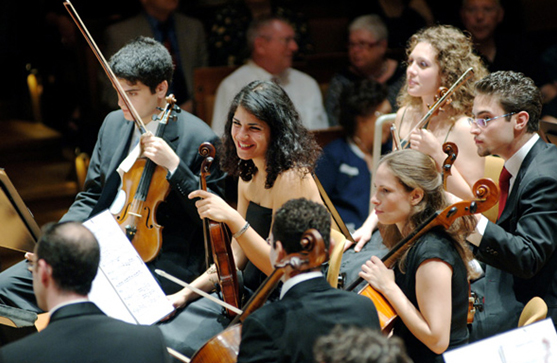
In 1999, Daniel Barenboim and the late Palestinian literary scholar Edward Said created a workshop for young musicians from Israel, Palestine and several Arab countries to promote coexistence and intercultural dialogue. They named the orchestra after Johann Wolfgang von Goethe’s collection of poems entitled “West-Eastern Divan”, a central work for the evolution of the concept of world culture.
The West-Eastern Divan Orchestra’s first sessions took place in Weimar and Chicago. In 2002, it found a permanent home in Seville, Spain, where it is generously supported by the regional government of Andalusia (Junta de Andalucia). An equal number of Israeli and Arab musicians form the base of the orchestra, together with a group of Spanish members. They meet each summer in Seville for a workshop, where rehearsals are complemented by lectures and discussions and followed by an international concert tour.
The West-Eastern Divan Orchestra has proved time and again that music can break down barriers previously considered insurmountable. The only political aspect that prevails in the work of the WEDO is the conviction that there is no military solution to the Arab-Israeli conflict, and that the destinies of Israelis and Palestinians are inextricably linked. Through its work and existence the West-Eastern Divan Orchestra demonstrates that bridges can be built to encourage people to listen to the narrative of the other.
While music alone cannot resolve the Arab-Israeli conflict, it grants the individual the right and obligation to express himself fully while listening to his neighbour. Based on this notion of equality, cooperation and justice for all, the orchestra represents an alternative model to the current situation in the Middle East.
The Orchestra’s repertoire expands beyond symphonic works to opera and chamber music performances. Concert highlights have included performances at Berlin’s Philharmonic Hall, the Teatro alla Scala in Milan, the Musikverein in Vienna, Carnegie Hall in New York, the Tchaikovsky Conservatory in Moscow, the Hagia Eirene Museum in Istanbul, the Salle Pleyel in Paris, the Plaza Mayor in Madrid and the Teatro Colon in Buenos Aires as well as a concert in honour of Secretary-General Kofi Annan at the General Assembly Hall of the United Nations in New York in December 2006. The orchestra is a regular guest at the BBC Proms and the Salzburg Festival.
The West-Eastern Divan Orchestra has released a number of highly acclaimed CDs/DVDs on Warner Classics and EuroArts. These include a concert at Victoria Hall in Geneva (2004), a live recording of Beethoven’s 9th Symphony at Berlin’s Philharmonic Hall (2006) and the emblematic concert at the Cultural Palace in Ramallah (2005). The documentary “Knowledge is the Beginning” has won several awards, among them an International Emmy (2006).

The West-Eastern Divan Orchestra 2011

In 2011, the orchestra will continue its focus on a cycle of all of Ludwig van Beethoven’s symphonies with two separate tours. May will see the Divan perform in the Middle East and Europe. The Summer Tour in August will take the musicians to Asia for the first time with concerts in Beijing, Shanghai and Seoul before it returns to a number of European venues, among them the festivals in Lucerne and Salzburg. Other highlights include a large-scale open air concert at the Waldbuhne in Berlin (for information, see www.waldbuehnenkonzert.de) and a recording of all Beethoven symphonies at the Cologne Philharmonic.


Sumi Jo Soprano
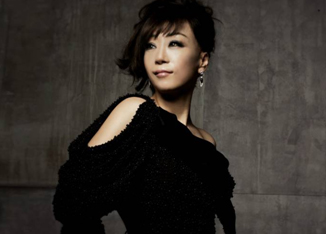
Praised for the remarkable agility, precision and warmth of her voice, and for her outstanding musicianship, Sumi Jo has established herself as one of her generation’s most sought-after sopranos. She has been consistently greeted with exceptional accolades, by public and press alike, for her performances in the most important opera houses and concert halls throughout the world.

Miss Jo has appeared as Marie in La Fille du Regiment in Santiago, Chile, and Elvira in I Puritani in concert with the Monnaie in Brussels and in Amsterdam. New additions to her repertoire in recent years have been Delibes’ Lakeme, Meyerbeer’s Dinorah and Giulietta in I Capuleti ed i Montecchi, which she sang for the Minnesota Opera. In 2007-8 she made her role debut as Violetta in La traviata in Toulon.

Her 2008-9 season included Marie in La Fille du Regiment for Hamburg State Opera, Bellini’s I Puritani in Bergamo, Fra Diavolo at the Opera Comique and Opera Royal de Wallonie in Liege, a gala concert with Jonas Kaufmann, Renee Fleming and Dmitri Hvorostovsky as part of the Olympic games in Beijing, a Christmas concert with Jose Carreras in Barcelona as well as solo concerts in Canada, United States, Hong Kong, Beijing, Singapore, Paris, Brussels, Barcelona, recital tours in Korea, Tokyo and Australia and duo concerts with Dmitri Hvorostovky in Asia, United States and Canada.

Sumi Jo is also in constant demand as a concert artist, both for special events such as the World Cup, an Asian tour of gala concerts with Andrea Bocelli, and a program of Viennese favorites with celebrated Cincinnati Pops. She has been heard in recital in major festivals and concert halls worldwide. In 2001 at Carnegie Hall, accompanied by The Orchestra of St. Luke’s, she gave her first public performances of Broadway Songs on her crossover album “Only Love”, which sold more than 1,200,000 copies worldwide, adding to her list of best-selling recordings.
At New York’s Metropolitan Opera Miss Jo has been heard in the title role of Lucia di Lammermoor , Gilda in Rigoletto , Olympia in Les Contes d’Hoffmann , Rosina in Il barbiere di Siviglia and Oscar in Un Ballo in maschera . La Scala audiences have heard her in bel canto specialties such as Le Comte Ory, Fra Diavol . At the Teatro Colon in Buenos Aires she has appeared as Gilda, Zerbinetta and Queen of the Night, the latter role of which was the vehicle of her Vienna State Opera debut. Other operas in her extensive repertoire include Donizetti’s La Fille du Regiment and Don Pasquale , Rossini’s Il Turco in Italia and Elisabetta, regina d’Inghilterra, Mozart’s Abduction from the Seraglio and Strauss’ Ariadne auf Naxos and Der Rosenkavalier .
Miss Jo currently has over 50 recordings to her credit, which include ten solo albums for Erato. Among them are a Grammy-winning Die Frau ohne Schatten with Sir Georg Solti for London/Decca and Un Ballo in Maschera for Deutsche Grammophon under Herbert von Karajan. She has also recorded The Magic Flute and an album of arias under the baton of Maestro Solti. In 2007 she signed an exclusivity contract with Universal Music.
Born in Korea, Sumi Jo studied in her native country before enrolling in the Conservatory of the Accademia di Santa Cecilia in Rome. Her recital debut in Seoul was followed by concerts with the Korean Broadcasting Company Orchestra. Her first operatic role was Susanna in Le Nozze di Figaro , which she also sang in Seoul. While studying in Italy, Miss Jo was frequently heard in concert in Italian cities and also in radio broadcasts and telecasts on the RAI Italian National Network. She graduated with honors from the Santa Cecilia Conservatory in October 1986.

Miss Jo has won many prestigious awards including first prizes at international competitions in Seoul, Naples, Enna, Barcelona and Pretoria. In August 1986 she was unanimously awarded first prize in the Carlo Alberto Cappelli International Competition at Verona, one of the world’s most important contests, open only to first prize-winners of other major competitions. She was elected as “Artist for Peace” of UNESCO in 2003. Miss Jo makes her home in Rome.


Ah-Kyung Lee Mezzo soprano
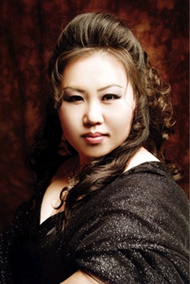
Ah-Kyung Lee was graduated from Kyung Hee University as Cum Laude in Korea and trained in Italy afaterwards.
She won 1st prize from many prestigious music competition such as Vincenzo Bellini International Concours, Viotti-Valsesia International Concours, Alcamo International Concours, Spiros Argiris International Concours, Mario Del Monaco International Concours, Giovanni Battista Velluti International Concours.

Ms. Lee made her debut in the National Opera of Korea in 1995 and performed as the prima donna in Aida, Don Carlo, Il Trovatore, Un ballo in Maschera, Rigoletto, The Midium, Mose, Faust, Madama Butterfly, Hansel und Gretel, Wedding, Il Signor Deluso, Sim-Thung By Isang Yun, Cosi fan tutte , Le Nozze di Figaro, Ah! Korea!, Jik-gi etc. Also, she performed as the prima donna in the opera “Il Trovatore” in Milano, Italy and in the opera “Aida” hosted by Toscanini foundation in Italy. She performed as "Azucena" in the opera "IL Trovatore" with tenor Giuseppe Giacomini at Seoul in 2008.


Ji-Min Park Tenor

Ji-Min Park trained at the Seoul National University, South Korea, and at the Vienna Conservatory, Austria, as a student of Professor Carolyn Hague and was a Jette Parker Young Artist at the Royal Opera House Covent Garden from 2007-2009.

Ji-Min has won several awards including the Vienna Staatsoper Special Prize, the International Belvedere Singing Competition in Austria, First Prize and Audience Prize at the International Art Song Competition in France and the performance prize in the Stella Maris International Vocal Competition onboard MS EUROPA in 2009. Ji-Min represented Korea in the BBC Cardiff Singer of the World competition 2009.

Ji-Min was a Jette Parker Principal Young Artist at the Royal Opera House last season, where roles included Sailor in Tristan und Isolde, Gastone in La Traviata, Rodolfo in La Boheme, Messenger in Aida and covering Carlo in Linda di Chamounix, Des Grieux in Manon, and Alfredo in La Traviata. Ji-Min joins the Royal Opera tour to Japan in the summer of 2010 to cover Des Grieux and sing Gastone in La Traviata and Handel’s Messiah in concert, conducted by Antonio Pappano.
In the 09/10 season Ji-Min represented Covent Garden in the Stella Maris International Vocal Competition onboard MS EUROPA, and was awarded European concerts. He gave recitals to open the Aalborg Opera Festival in Denmark, for the Royal Opera House lunchtime series, with Audley Male Voice Choir in Stoke on Trent, accompanied by Ingrid Surgenor, and with the JPYAP young artists in Gstaad, Switzerland accompanied by David Gowland.
In the 2010/11 season Ji-Min will make his debut at Theatre du Capitole Toulouse as Rodolfo in La Boheme, cover Romeo in Romeo et Juliette at Covent Garden, sing Alfredo in La Traviata for New Israeli Opera and Rodolfo in La Boheme for Opera Australia in Sydney and Melbourne. In concert he will sing Beppe in Pagliacci with the Swedish Radio Symphony Orchestra conducted by Daniel Harding, Die Drei Pintos with the Gulbenkian Orchestra conducted by Lawrence Foster, and Opera Galas with the Deutsche Radio Philharmonie Saarbrucken in Frankfurt and Karlsruhe.

Further ahead Ji-Min performs Rossini’s Stabat Mater with the London Philharmonic Orchestra conducted by Yannick Nezet-Seguin, Edgardo in Lucia di Lammermoor for New Israeli Opera, and Iopas in a new production of les Troyens at the Royal Opera House, Covent Garden, conducted by Antonio Pappano.


Maurice Hamm BASS
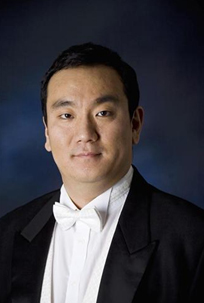
Bass Hamm was trained in Korea, graduating from DanKook University, which was followed by studies in Staatliche Hochschule fur Musik und Darstellende Kunst Stuttgart, Kunsterliche Aufbaustudium.
Mr. Hamm won prizes at concurs Internacional de Cant Jaume Aragall in Spain, internationaler Gesangswettbewerb Koln in Germany, and in internationaler Gesangswettbewerb Debut in Meran in Italy.
Mr. Hamm made his debut as Baum, Lehnstuhl of Ravel “Das Kind und die Zauberdinge” in Wurttembergische Staatstheater Stuttgart Opera House
Also, he has appeared many operas such as “The Jumping Frog[Fremmder]” ? Stuttgart Opera House, “Die Zauberflote[Sarastro]”- Merano Theatre, and ?“Aida[Il Re]", “Die Kluge[Bauer]”, “Agrippina[Lesbo]” - Halle Opera House in Germany.

He also performed with renowned Maestros like Riccardo Frizza, Marcus Creed, Maurizio Benini, Pier Giorgio Morandi

Venue & Seating Chart

Iimjingak Pyeonghoa-Nuri Park
Iimjingak Pyeonghoa-Nuri Park 618-13 Majeong-ri Munsan-eup Paju-shi Gyenggi-do Rep. of Korea
031-953-4857

Daniel Barenboim & The West-Eastern Divan Orchestra Peace Concert

Daniel Barenboim & The West-Eastern Divan Orchestra Peace Concert

Date/Time
Aug 15, 2011
Genre
Classic
Venue
Iimjingak Pyeonghoa-Nuri Park
Age group
5 years and over
Run time
1 hr 20 min
1/3
Untitled Document

Daniel Barenboim & The West-Eastern Divan Orchestra Peace Concert


Date, Time and Venue

August 15, 2011 at 7 PM, Outdoor Performance Hall, Imjingak Pyeonghoa-Nuri

Program: Beethoven Symphony No. 9

Artists:
Daniel Barenboim (Conductor), West-Eastern Divan Orchestra
Soprano Sumi Jo, Mezzo Soprano Ah-Kyung Lee,
Tenor Ji-Min Park, Bass Maurice Hamm
United Choir (National Chorus, Goyang City Choir, Seoul Motet Choir)

Tickets: Picnic seat - 35,000 won (seating mats provided) , 20% discount on all purchases above 3


A Melody of Miracle to Resonate Through DMZ!

A Must-See Concert by Barenboim, Sumi Jo and the West-Eastern Divan Orchestra
- A Musical Message of Peace
On August 15 (7 PM) the legendary pianist and conductor Daniel Barenboim will stand before an audience comprising citizens of the only remaining divided state in the world in the demilitarized zone of the Korean peninsula. Barenboim will deliver a message of peace through the music he will present with the West-Eastern Divan Orchestra and South Korean soloists including the superstar soprano Sumi Jo. The concert will carry special significance as it will take place on the grounds of the Cold War’s last frontier featuring not only the Maestro himself, but also an orchestra which consists of young musicians from the world’s most concentrated area of conflict - Israel, Palestine and several Arab countries. As soloists Sumi Jo, a Diva Soprano celebrated both domestically and abroad, Ah-Kyung Lee, a Mezzo Soprano highly praised by classical music fans for her remarkable talent, Ji-Min Park, a rising-star Tenor of the Royal Opera of Great Britain, and Maurice Hamm, a Bass singer described by critics as a hidden treasure will appear on stage with the orchestra and conductor.

The Hottest Issue in Culture, Diplomacy, and Politics of the Global Community of 2011!
A Concert on August 15, National Independence Day, to Resound Harmony throughout the DMZ!
On August 15, Young musicians from Israel, Palestine and several Arab countries - an area struck with constant conflict caused by ideological differences - will gather under the name of West-Eastern Divan Orchestra to perform Beethoven Symphony No. 9, also known as ‘Ode to Joy’ at Imjingak Pyeonghwa-Nuri. A grassy field bordering the demilitarized zone between North and South Korea, the location of the concert along with the date of the event signify the underlying message of the event - to emphasize the importance of peace by commemorating Korea’s independence from Japanese colonization and the end of World War II.
The concert, which will take place in the world’s only remaining divided state at a time when tension between the two Koreas has heightened due to recent clashes, will revive the miraculous and moving memory of the performance in 2005 by the same orchestra and conductor at Ramallah, Palestine, an area also agitated by political divide.
On August 15, 2011, the world will witness yet another miracle that will touch the hearts of audiences the world over.

A Performance of Symphony No.9 by Beethoven, the Most Beloved Composer in Korea & Sumi-Jo, Korea’s Favorite Soprano!
Beethoven, the most beloved composer among Korean audiences is also a special name in the musical career of Barenboim. As a pianist Barenboim recorded the full cycle of Beethoven’s piano sonatas and rose to the top of the world’s classical music scene. In his upcoming concert in Korea, he will deliver one of Beethoven’s most familiar works as the conductor of an orchestra he co-founded with the Palestinian-American scholar Edward Said. The fact that the concert will present a work which Beethoven completed despite his hearing loss delivers a message of joy and hope in itself.
Beethoven Symphony No. 9 performed by the West-Eastern Divan Orchestra under the baton of Daniel Barenboim and the world-class soprano Sumi Jo on the hill of Imjingak Pyeonghwa-Nuri will send a message of peace throughout the international community. With the fourth movement of the Symphony will begin the ‘Ode to Joy’ filled with the lively and festive mood characteristic of its melody. As the vocals meet the sound of the instruments the music will come together and lead the audience and artists to unite as if to reflect the lyrics of the movement which reads “all men will become brothers.” And as the words of the refrain suggest, the music of the joyful Symphony resonating through Imjingak will bring audiences of the world together to “be embraced, [as] millions!” under consolidated hope of bringing peace and harmony to the peninsula and beyond.

PROFILE

Daniel Barenboim Conductor

Daniel Barenboim is one of the few musicians in the world today who could accurately be described as legendary" (The Times)

Daniel Barenboim was born in Buenos Aires in 1942 to parents of Jewish Russian descent. He started piano lessons at the age of five with his mother, continuing to study with his father who remained his only other teacher. In August 1950, when he was only seven years old, he gave his first official concert in Buenos Aires. 

Important influences in his development as a musician included Artur Rubinstein and Adolf Busch, both of whom performed in Argentina. The Barenboim family moved to Israel in 1952. Two years later, in the summer of 1954, the parents brought their son to Salzburg to take part in Igor Markevich's conducting classes. During that same summer he also met Wilhelm Furtwangler, played for him and attended some of the great conductor's rehearsals and a concert. Furtwangler subsequently wrote a letter including the words "the eleven year-old Barenboim is a phenomenon …" This phrase was to open many doors to Daniel Barenboim for a long time to come. In 1955 the young Daniel Barenboim studied harmony and composition with Nadia Boulanger in Paris.

Barenboim made his debut as a pianist in Vienna and Rome in 1952, in Paris in 1955, in London in 1956 and in New York in 1957 with Leopold Stokowski and the Symphony of the Air. From then on, he made annual concert tours of the United States and Europe. He toured Australia in 1958 and soon became known as one of the most versatile pianists of his generation.

He made his first gramophone recordings in 1954 and soon began recording the most important works in the piano repertoire, including complete piano sonatas cycles of Mozart and Beethoven and concerto cycles of Mozart, Beethoven (with Otto  Klemperer), Brahms (with Sir John Barbirolli) and Bartok (with Pierre Boulez).
During the same period, Barenboim began to devote more time to conducting. His close relationship with the English Chamber Orchestra which began in 1965 lasted over a decade. During this time they performed frequently in England with Barenboim as both conductor and piano soloist and went on tour in Europe, the United States, Japan, Australia and New Zealand. Following his conducting debut with the New Philharmonia Orchestra in London in 1967, Barenboim began to conduct all the leading European and American symphony orchestras. Between 1975 and 1989 he was Music Director of the Orchestre de Paris, his tenure marked by a commitment to contemporary music including works by Lutoslawski, Berio, Boulez, Henze, Dutilleux, Takemitsu and others.
Daniel Barenboim has always been active as a chamber musician, performing with, among others, cellist Jacqueline du Pre (his late wife), Gregor Piatigorsky, Itzhak Perlman and Pinchas Zukerman. Collaborations with illustrious singers have included Dietrich Fischer-Dieskau, Thomas Quasthoff, Rolando Villazon and Dorothea Roschmann. In recent years he has performed chamber music at the Jerusalem International Chamber Music Festival and with members of the Staatskapelle Berlin.
Daniel Barenboim made his opera conducting debut in 1973 with a performance of Mozart's Don Giovanni at the Edinburgh International Festival. In 1981 he made his debut at the Bayreuth Festival, where he has conducted Tristan und Isolde, the Ring cycle, Parsifal and Die Meistersinger.
In 1991 he succeeded Sir Georg Solti as Music Director of the Chicago Symphony Orchestra, with whom he enjoyed countless successes in all the world's great concert halls for fifteen years. At the conclusion of his tenure in June 2006, the CSO musicians adopted a resolution naming him "our honorary conductor for life." In 1992 he became General Music Director of the Deutsche Staatsoper Berlin (German State Opera Berlin). In the autumn of 2000, the Staatskapelle Berlin appointed him Chief Conductor for Life. 
Barenboim continues to appear as a regular guest conductor with the Berlin Philharmonic and Vienna Philharmonic orchestras. In 2006 he was named Maestro Scaligero at La Scala, Milan, where he conducted Patrice Chereau’s acclaimed production of Tristan und Isolde in December 2007. Barenboim is a prolific recording artist and has made recordings since 1954 for Westminster, EMI, Deutsche Grammophon, Decca, Philips, Sony Classical (CBS Masterworks), BMG, Erato Disques and Teldec Classics International. He has won multiple Grammy Awards over the years.

In addition to Barenboim’s indisputable musical authority, he has become increasingly vocal in non-musical issues over the years. A Jew born during the Second World War and an Israeli by nationality, he has worked closely over many years with three German orchestras - the Berlin Philharmonic, the Staatskapelle Berlin and the Bayreuth Festival Orchestra in an atmosphere of mutual affection and respect.
In the early 1990s, a chance meeting between Barenboim and the late Palestinian-born writer and Columbia University professor Edward Said in a London hotel lobby led to an intensive friendship that has had both political and musical repercussions. These two men, who should have been poles apart politically, discovered in that first meeting, which lasted for hours, that they had similar visions for the future of potential Israeli/Palestinian cooperation. They decided to continue their dialogue and to collaborate on musical events to further their shared vision of peaceful co-existence in the Middle East. This led to Barenboim's first concert on the West Bank, a piano recital at the Palestinian Birzeit University in February 1999. It also led to a workshop for young musicians from the Middle East that took place in Weimar, Germany, in August 1999: this group was to become the West-Eastern Divan Orchestra.
The West-Eastern Divan Workshop took two years to organize and involved talented young musicians between the ages of 14 and 25 from Egypt, Syria, Lebanon, Jordan, Tunisia and Israel. The idea was that they would come together to make music on neutral ground with the guidance of some of the world's best musicians. Weimar was chosen as the site for the workshop because of its rich cultural tradition of writers, poets, musicians and creative artists and because it was the 1999 European cultural capital. Barenboim wisely chose two concertmasters for the orchestra, an Israeli and a Lebanese. There were some tense moments among the young players at first, but after being coached by members of the Berlin Philharmonic, the Chicago Symphony and the Staatskapelle Berlin, and having master classes with the cellist Yo-Yo Ma and nightly cultural discussions with Said and Barenboim, the young musicians worked and played in increasing harmony.
The West-Eastern Divan Workshop was held again in Weimar in the summer of 2000 and in Chicago in the summer of 2001. It has since found a permanent home in Seville, Spain, where it has been based since 2002. Each summer, following their workshop, the West-Eastern Divan Orchestra gives public concerts; to date it has performed in Europe and North and South America, including appearances at the BBC Proms and the Edinburgh, Lucerne and Salzburg festivals. In 2005, they performed a historic concert in the Cultural Palace in Ramallah, which was broadcast on television internationally and recorded on DVD. In December 2006, the West-Eastern Divan Orchestra went to the U.S.A., performing at Carnegie Hall and ending the tour with a farewell concert at the United Nations for outgoing Secretary General Kofi Annan. In 2007, the West-Eastern Divan Orchestra was invited to be in residence at the Salzburg Festival.
Edward Said passed away in 2003 but his partnership with Daniel Barenboim lives on through the West-Eastern Divan Orchestra and through the Barenboim-Said Foundation, which promotes music and co-operation through projects targeted at young Arabs and Israelis. In January 2005, Daniel Barenboim delivered the first Edward Said Lecture at Columbia University in New York City. Said’s widow Mariam continues to actively support and work for the orchestra and the Barenboim-Said Foundation.
Mr. Barenboim is keen to draw young people to music, believing in the transformative power of music. To this end, he was instrumental in founding music kindergartens in Ramallah and Berlin in 2004 and 2005 respectively. Through the Seville-based Barenboim-Said Foundation and his own Berlin-based Barenboim Foundation, he has inspired the creation of an Early Childhood Music Education Project, a Music Education Project in the Middle East and an Academy of Orchestral Studies in Seville. Both foundations continue to support musical education in the West Bank and in Nazareth, where instrumental lessons are given at the newly opened Edward Said Conservatory, headed by Nabeel Abboud-Ashkar, a violinist from the West-Eastern Divan Orchestra. On March 28th, 2008, Barenboim gave a special concert in Jerusalem with young Israeli and Palestinian musicians on the occasion of Israel’s 60th anniversary. 

In October 2002 Daniel Barenboim and Edward Said jointly received Spain's prestigious Prince of Asturias Concord Prize for their work in founding the West-Eastern Divan Workshop. Mr. Barenboim was also named an honorary citizen of Spain. In November 2002 he was awarded the Tolerance Prize by the Protestant Academy of Tutzing, in southwestern Germany, for his efforts to bring Palestinians and Israelis together through music. The same month, the president of Germany awarded Mr. Barenboim the Grosses Bundesverdienstkreuz, the highest honor given to someone who is not a head of state. In 2004, Mr. Barenboim received the Buber-Rosenzweig Medal, the Wolf Prize for the Arts in the Knesset in Jerusalem and the Haviva Reik Peace Award. In 2005, he won the Special Ambassador of Music Prize of Echo Klassik and was named the 2006 Charles Eliot Norton Professor of Poetry at Harvard University where he delivered six lectures in autumn 2006. Also in 2006, Daniel Barenboim won the Kulturgroschen award, the Peace Prize from the Korn and Gerstenmann Foundation and the Music Prize of the Ernst von Siemens Music Foundation. He was the first performer ever chosen to deliver the prestigious BBC Reith Lectures, which he delivered in London, Chicago, Berlin and Jerusalem; they were broadcast in the UK and on the BBC World Service.
In 2007, Daniel Barenboim was awarded the Goethe Medal by the Goethe Institute and was given an Honorary Doctorate of Music degree by Oxford University; he was named Commandeur de la legion d’honneur by the French President Jacques Chirac and received the Praemium Imperiale award in Japan. United Nations Secretary General Ban Ki Moon named Barenboim United Nations Messenger of Peace in September 2007. In the same year, he was also awarded the Royal Philharmonic Society Gold Medal, one of the most prestigious honors in classical music. In May 2008, he became an honorary citizen of the city of Buenos Aires (ciudadano ilustre), and in February 2009, he was awarded the Moses Mendelssohn Medal for his contribution to tolerance and international understanding.

Mr. Barenboim is the author of A Life in Music and Everything is Connected (US title: Music Quickens Time). He is the co-author of Parallels and Paradoxes: Explorations in Music and Society, a series of conversations between Daniel Barenboim and Edward Said, and Dialoghi su musica e teatro: Tristano e Isotta with Patrice Chereau, a lengthy dialogue on the relationship between stage director and conductor in the production of the opera Tristan und Isolde.


WEST EASTERN DIVAN ORCHESTRA

In 1999, Daniel Barenboim and the late Palestinian literary scholar Edward Said created a workshop for young musicians from Israel, Palestine and several Arab countries to promote coexistence and intercultural dialogue. They named the orchestra after Johann Wolfgang von Goethe’s collection of poems entitled “West-Eastern Divan”, a central work for the evolution of the concept of world culture.
The West-Eastern Divan Orchestra’s first sessions took place in Weimar and Chicago. In 2002, it found a permanent home in Seville, Spain, where it is generously supported by the regional government of Andalusia (Junta de Andalucia). An equal number of Israeli and Arab musicians form the base of the orchestra, together with a group of Spanish members. They meet each summer in Seville for a workshop, where rehearsals are complemented by lectures and discussions and followed by an international concert tour.
The West-Eastern Divan Orchestra has proved time and again that music can break down barriers previously considered insurmountable. The only political aspect that prevails in the work of the WEDO is the conviction that there is no military solution to the Arab-Israeli conflict, and that the destinies of Israelis and Palestinians are inextricably linked. Through its work and existence the West-Eastern Divan Orchestra demonstrates that bridges can be built to encourage people to listen to the narrative of the other.
While music alone cannot resolve the Arab-Israeli conflict, it grants the individual the right and obligation to express himself fully while listening to his neighbour. Based on this notion of equality, cooperation and justice for all, the orchestra represents an alternative model to the current situation in the Middle East.
The Orchestra’s repertoire expands beyond symphonic works to opera and chamber music performances. Concert highlights have included performances at Berlin’s Philharmonic Hall, the Teatro alla Scala in Milan, the Musikverein in Vienna, Carnegie Hall in New York, the Tchaikovsky Conservatory in Moscow, the Hagia Eirene Museum in Istanbul, the Salle Pleyel in Paris, the Plaza Mayor in Madrid and the Teatro Colon in Buenos Aires as well as a concert in honour of Secretary-General Kofi Annan at the General Assembly Hall of the United Nations in New York in December 2006. The orchestra is a regular guest at the BBC Proms and the Salzburg Festival.
The West-Eastern Divan Orchestra has released a number of highly acclaimed CDs/DVDs on Warner Classics and EuroArts. These include a concert at Victoria Hall in Geneva (2004), a live recording of Beethoven’s 9th Symphony at Berlin’s Philharmonic Hall (2006) and the emblematic concert at the Cultural Palace in Ramallah (2005). The documentary “Knowledge is the Beginning” has won several awards, among them an International Emmy (2006).

The West-Eastern Divan Orchestra 2011

In 2011, the orchestra will continue its focus on a cycle of all of Ludwig van Beethoven’s symphonies with two separate tours. May will see the Divan perform in the Middle East and Europe. The Summer Tour in August will take the musicians to Asia for the first time with concerts in Beijing, Shanghai and Seoul before it returns to a number of European venues, among them the festivals in Lucerne and Salzburg. Other highlights include a large-scale open air concert at the Waldbuhne in Berlin (for information, see www.waldbuehnenkonzert.de) and a recording of all Beethoven symphonies at the Cologne Philharmonic.


Sumi Jo Soprano

Praised for the remarkable agility, precision and warmth of her voice, and for her outstanding musicianship, Sumi Jo has established herself as one of her generation’s most sought-after sopranos. She has been consistently greeted with exceptional accolades, by public and press alike, for her performances in the most important opera houses and concert halls throughout the world.

Miss Jo has appeared as Marie in La Fille du Regiment in Santiago, Chile, and Elvira in I Puritani in concert with the Monnaie in Brussels and in Amsterdam. New additions to her repertoire in recent years have been Delibes’ Lakeme, Meyerbeer’s Dinorah and Giulietta in I Capuleti ed i Montecchi, which she sang for the Minnesota Opera. In 2007-8 she made her role debut as Violetta in La traviata in Toulon.

Her 2008-9 season included Marie in La Fille du Regiment for Hamburg State Opera, Bellini’s I Puritani in Bergamo, Fra Diavolo at the Opera Comique and Opera Royal de Wallonie in Liege, a gala concert with Jonas Kaufmann, Renee Fleming and Dmitri Hvorostovsky as part of the Olympic games in Beijing, a Christmas concert with Jose Carreras in Barcelona as well as solo concerts in Canada, United States, Hong Kong, Beijing, Singapore, Paris, Brussels, Barcelona, recital tours in Korea, Tokyo and Australia and duo concerts with Dmitri Hvorostovky in Asia, United States and Canada.

Sumi Jo is also in constant demand as a concert artist, both for special events such as the World Cup, an Asian tour of gala concerts with Andrea Bocelli, and a program of Viennese favorites with celebrated Cincinnati Pops. She has been heard in recital in major festivals and concert halls worldwide. In 2001 at Carnegie Hall, accompanied by The Orchestra of St. Luke’s, she gave her first public performances of Broadway Songs on her crossover album “Only Love”, which sold more than 1,200,000 copies worldwide, adding to her list of best-selling recordings.
At New York’s Metropolitan Opera Miss Jo has been heard in the title role of Lucia di Lammermoor , Gilda in Rigoletto , Olympia in Les Contes d’Hoffmann , Rosina in Il barbiere di Siviglia and Oscar in Un Ballo in maschera . La Scala audiences have heard her in bel canto specialties such as Le Comte Ory, Fra Diavol . At the Teatro Colon in Buenos Aires she has appeared as Gilda, Zerbinetta and Queen of the Night, the latter role of which was the vehicle of her Vienna State Opera debut. Other operas in her extensive repertoire include Donizetti’s La Fille du Regiment and Don Pasquale , Rossini’s Il Turco in Italia and Elisabetta, regina d’Inghilterra, Mozart’s Abduction from the Seraglio and Strauss’ Ariadne auf Naxos and Der Rosenkavalier .
Miss Jo currently has over 50 recordings to her credit, which include ten solo albums for Erato. Among them are a Grammy-winning Die Frau ohne Schatten with Sir Georg Solti for London/Decca and Un Ballo in Maschera for Deutsche Grammophon under Herbert von Karajan. She has also recorded The Magic Flute and an album of arias under the baton of Maestro Solti. In 2007 she signed an exclusivity contract with Universal Music.
Born in Korea, Sumi Jo studied in her native country before enrolling in the Conservatory of the Accademia di Santa Cecilia in Rome. Her recital debut in Seoul was followed by concerts with the Korean Broadcasting Company Orchestra. Her first operatic role was Susanna in Le Nozze di Figaro , which she also sang in Seoul. While studying in Italy, Miss Jo was frequently heard in concert in Italian cities and also in radio broadcasts and telecasts on the RAI Italian National Network. She graduated with honors from the Santa Cecilia Conservatory in October 1986.

Miss Jo has won many prestigious awards including first prizes at international competitions in Seoul, Naples, Enna, Barcelona and Pretoria. In August 1986 she was unanimously awarded first prize in the Carlo Alberto Cappelli International Competition at Verona, one of the world’s most important contests, open only to first prize-winners of other major competitions. She was elected as “Artist for Peace” of UNESCO in 2003. Miss Jo makes her home in Rome.


Ah-Kyung Lee Mezzo soprano

Ah-Kyung Lee was graduated from Kyung Hee University as Cum Laude in Korea and trained in Italy afaterwards.
She won 1st prize from many prestigious music competition such as Vincenzo Bellini International Concours, Viotti-Valsesia International Concours, Alcamo International Concours, Spiros Argiris International Concours, Mario Del Monaco International Concours, Giovanni Battista Velluti International Concours.

Ms. Lee made her debut in the National Opera of Korea in 1995 and performed as the prima donna in Aida, Don Carlo, Il Trovatore, Un ballo in Maschera, Rigoletto, The Midium, Mose, Faust, Madama Butterfly, Hansel und Gretel, Wedding, Il Signor Deluso, Sim-Thung By Isang Yun, Cosi fan tutte , Le Nozze di Figaro, Ah! Korea!, Jik-gi etc. Also, she performed as the prima donna in the opera “Il Trovatore” in Milano, Italy and in the opera “Aida” hosted by Toscanini foundation in Italy. She performed as "Azucena" in the opera "IL Trovatore" with tenor Giuseppe Giacomini at Seoul in 2008.


Ji-Min Park Tenor

Ji-Min Park trained at the Seoul National University, South Korea, and at the Vienna Conservatory, Austria, as a student of Professor Carolyn Hague and was a Jette Parker Young Artist at the Royal Opera House Covent Garden from 2007-2009.

Ji-Min has won several awards including the Vienna Staatsoper Special Prize, the International Belvedere Singing Competition in Austria, First Prize and Audience Prize at the International Art Song Competition in France and the performance prize in the Stella Maris International Vocal Competition onboard MS EUROPA in 2009. Ji-Min represented Korea in the BBC Cardiff Singer of the World competition 2009.

Ji-Min was a Jette Parker Principal Young Artist at the Royal Opera House last season, where roles included Sailor in Tristan und Isolde, Gastone in La Traviata, Rodolfo in La Boheme, Messenger in Aida and covering Carlo in Linda di Chamounix, Des Grieux in Manon, and Alfredo in La Traviata. Ji-Min joins the Royal Opera tour to Japan in the summer of 2010 to cover Des Grieux and sing Gastone in La Traviata and Handel’s Messiah in concert, conducted by Antonio Pappano.
In the 09/10 season Ji-Min represented Covent Garden in the Stella Maris International Vocal Competition onboard MS EUROPA, and was awarded European concerts. He gave recitals to open the Aalborg Opera Festival in Denmark, for the Royal Opera House lunchtime series, with Audley Male Voice Choir in Stoke on Trent, accompanied by Ingrid Surgenor, and with the JPYAP young artists in Gstaad, Switzerland accompanied by David Gowland.
In the 2010/11 season Ji-Min will make his debut at Theatre du Capitole Toulouse as Rodolfo in La Boheme, cover Romeo in Romeo et Juliette at Covent Garden, sing Alfredo in La Traviata for New Israeli Opera and Rodolfo in La Boheme for Opera Australia in Sydney and Melbourne. In concert he will sing Beppe in Pagliacci with the Swedish Radio Symphony Orchestra conducted by Daniel Harding, Die Drei Pintos with the Gulbenkian Orchestra conducted by Lawrence Foster, and Opera Galas with the Deutsche Radio Philharmonie Saarbrucken in Frankfurt and Karlsruhe.

Further ahead Ji-Min performs Rossini’s Stabat Mater with the London Philharmonic Orchestra conducted by Yannick Nezet-Seguin, Edgardo in Lucia di Lammermoor for New Israeli Opera, and Iopas in a new production of les Troyens at the Royal Opera House, Covent Garden, conducted by Antonio Pappano.


Maurice Hamm BASS

Bass Hamm was trained in Korea, graduating from DanKook University, which was followed by studies in Staatliche Hochschule fur Musik und Darstellende Kunst Stuttgart, Kunsterliche Aufbaustudium.
Mr. Hamm won prizes at concurs Internacional de Cant Jaume Aragall in Spain, internationaler Gesangswettbewerb Koln in Germany, and in internationaler Gesangswettbewerb Debut in Meran in Italy.
Mr. Hamm made his debut as Baum, Lehnstuhl of Ravel “Das Kind und die Zauberdinge” in Wurttembergische Staatstheater Stuttgart Opera House
Also, he has appeared many operas such as “The Jumping Frog[Fremmder]” ? Stuttgart Opera House, “Die Zauberflote[Sarastro]”- Merano Theatre, and ?“Aida[Il Re]", “Die Kluge[Bauer]”, “Agrippina[Lesbo]” - Halle Opera House in Germany.

He also performed with renowned Maestros like Riccardo Frizza, Marcus Creed, Maurizio Benini, Pier Giorgio Morandi

Price

More detailed ticket information will be available when you book the tickets.

Venue & Seating Chart

Iimjingak Pyeonghoa-Nuri Park
Iimjingak Pyeonghoa-Nuri Park 618-13 Majeong-ri Munsan-eup Paju-shi Gyenggi-do Rep. of Korea
031-953-4857